We all want students to read and write well. The problem is that many children see those subjects as either boring or too difficult. That is where gamifying literacy might help.
Enjoyable activities not only help students engage in learning more but also strengthen their understanding. The Education Program at CRB has been doing the science of reading courses and has come across many research studies. One such study is “Enhancing Reading Instruction through Gamification: A Systematic Review of Theoretical Models, Implementation Strategies, and Measurable Outcomes” by Zhiru Wang, Jamalludin Harun, and Yihuan Yuan. In their research paper, they state that:
“Primary school extensively incorporates gamified reading instruction, emphasizing the use of badges, leaderboards, narrative contexts, and avatars to foster captivating and individualized learning experiences. Multiple studies consistently demonstrate that the integration of game aspects into reading teaching leads to improvements in reading speed, reading accuracy, reading immersion, interactivity, and frequency.”
The key is to make students engage in reading and writing without them thinking they are studying or learning. We can all remember classes we took in school that are more memorable than others. Those that are commonly more memorable are the ones we felt enjoyment from and saw the activity more as a game or puzzle rather than work to do.
In the previously mentioned study, the authors have some excellent recommendations for educators, “Educators are encouraged to integrate gamification elements tailored to different educational stages, such as badges and narrative contexts in primary education and collaborative challenges in higher education, to enhance student engagement and comprehension.” The authors also state that, “implementing gamification in reading instruction has the potential to positively influence reading comprehension and student motivation, ultimately leading to improved educational results on a larger scale.” Motivation is often a key factor in students wanting to improve in their reading.
In another research paper, “Game on! Improving reading habits: Using gamification to enhance learner motivation and participation” by Jennifer Sheokarah, social-emotional improvement can be seen in gamified literacy: “Findings indicate that gamified activities foster a more engaging and interactive learning environment, encouraging second language learners to take an active role in improving their reading habits. Through competitive and collaborative games, learners demonstrated increased enthusiasm and developed confidence in their reading journeys.” Enthusiasm and confidence are great indicators of children enjoying reading and writing.
So, in your classrooms, the Education Program at CRB highly recommends gamifying your reading and writing, including other subjects you teach.
Sources
Wang, Zhiru, et al. “Enhancing Reading Instruction through Gamification: A Systematic Review of Theoretical Models, Implementation Strategies, and Measurable Outcomes (2020-2024)..” Journal of Information Technology Education: Research, vol. 23, Informing Science Institute. 131 Brookhill Court, Santa Rosa, CA 95409. Tel: 707-531-4925; Fax: 480-247-5724; e-mail: contactus@informingscience.org; Web site: http://www.informingscience.org/Journals/JITEResearch/Overview, 2024, https://eric.ed.gov/?id=EJ1463305. Accessed 1 Oct. 2026.
Sheokarah, Jennifer. “Game on! Improving Reading Habits: Using Gamification to Enhance Learner Motivation and Participation.” Journal of Education, no. 102, Academy of Science of South Africa, 2025, https://doi.org/10.17159/2520-9868/i102a01.
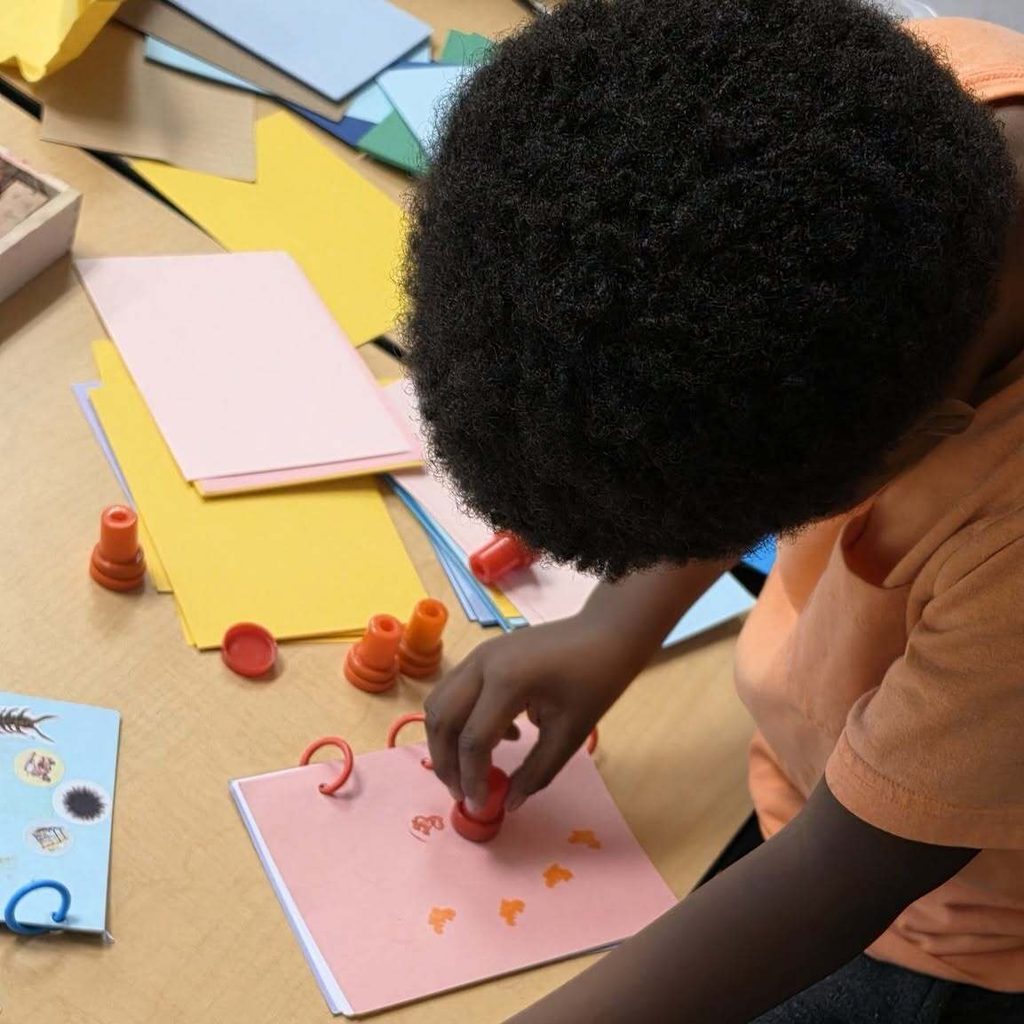
[Student making his own book]
Leave a Reply